It's the question almost every business in Kuwait asks before spending its first dinar on advertising: Meta or Google? Instagram and Snapchat feel unavoidable here — but so does the pull of showing up the moment someone searches. The honest answer is that they're not really competitors. They do two fundamentally different jobs, and picking the right one to start with depends entirely on what you sell and how people buy it.
This guide cuts through it: what actually separates the two, when each one is the smarter first move, how the Kuwait market changes the maths, and how to split a starting budget without setting money on fire.
The short answer
Start with Google Ads when people are already searching for what you offer — you're capturing demand that exists today. Start with Meta (Instagram & Facebook) when you need to create demand — showing a product to people who'd want it but aren't looking yet. If customers actively search for your service ("plumber in Salmiya", "orthodontist Kuwait"), lead with Google. If you sell something visual, impulse-driven, or new that people discover rather than search for, lead with Meta.
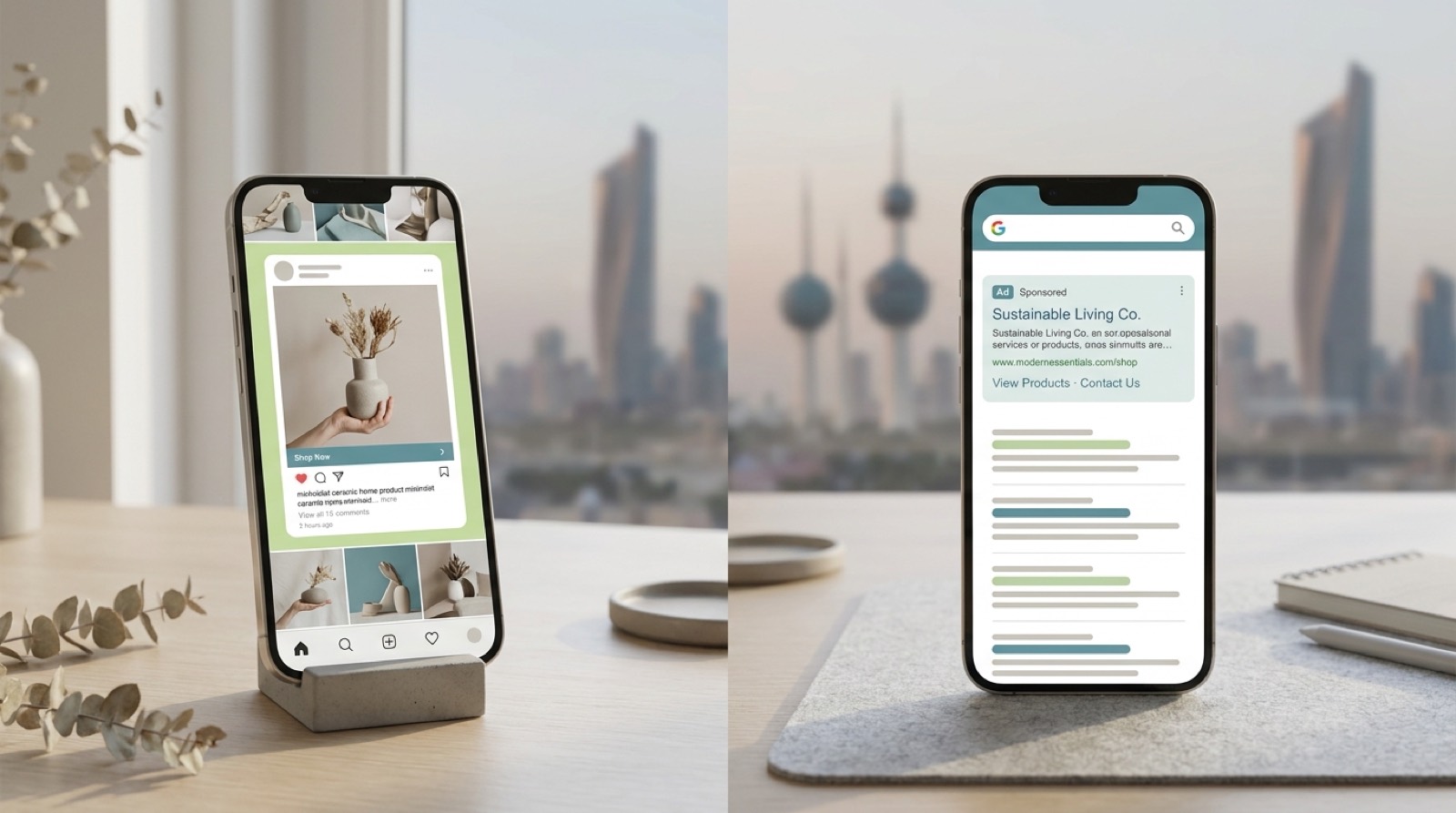
The core difference: demand capture vs demand creation
Everything comes back to one distinction.
- Google Ads is demand capture (pull). Someone types a query with clear intent, and your ad appears at that exact moment. The intent is already there — you're just making sure you're the one they find. Higher intent usually means a higher conversion rate, but you can only reach as many people as are actually searching.
- Meta Ads is demand creation (push). Nobody opens Instagram to be sold to — they're scrolling. Your ad interrupts with something interesting enough to stop the thumb. You can reach a massive audience and precisely target interests, behaviours, and lookalikes, but you're warming up cold attention, so it takes stronger creative and a bit more patience.
Put simply: Google finds people looking for you; Meta finds people who'd want you but don't know you yet. One isn't better than the other — they sit at different points in how a customer decides to buy.
When to start with Google
Google is usually the smarter first move when:
- People actively search for what you do. Services with clear intent — clinics, lawyers, repair, home services, B2B, "near me" needs — get bought the moment someone needs them.
- The purchase is urgent or considered. A broken AC in a Kuwait summer, an emergency dentist, a car service — nobody waits to be inspired; they search and buy.
- You need leads fast to prove the maths. Search traffic converts quickly, so you learn your real cost-per-lead within days, not weeks.
- Your margins can absorb the click cost. Competitive keywords cost more per click, but a single closed customer often pays for many of them.
The catch: Google only works if demand exists. If barely anyone searches for what you sell, you'll run out of traffic quickly — and that's exactly where Meta earns its place. Note that "Google Ads" also includes YouTube and the Display network, but for most Kuwait businesses starting out, it's search intent that does the heavy lifting.
When to start with Meta
Meta (Instagram and Facebook) is usually the smarter first move when:
- Your product is visual or lifestyle-driven. Fashion, food, beauty, interiors, gyms, cafés, events — things people fall for by seeing, not searching.
- You're creating a new category or brand. If customers don't yet know your product exists, they can't search for it. You have to show them.
- Purchases are impulse or emotion-led. A great video or carousel can turn a casual scroller into a buyer on the spot.
- You want reach and brand-building on a budget. Meta's cost-per-impression is low, so you can build awareness and retarget affordably.
The catch: Meta lives or dies on creative. A weak ad drains budget quietly. Strong, native-feeling video and images — plus a clear offer — are what make it work. It also usually needs a slightly longer runway than search before the numbers settle.
The Kuwait reality
Kuwait tilts the decision in a few important ways:
- Social usage is exceptionally high. Instagram and Snapchat are woven into daily life, and time-on-app is among the highest in the world. That makes Meta (and Snapchat) unusually strong for reach and discovery here.
- But search intent is real and undercompetitive. Many Kuwait businesses ignore Google, which often means cheaper clicks and easier visibility for the ones who show up — especially in Arabic.
- Bilingual matters. Arabic and English audiences behave differently. The best campaigns run and test both, rather than assuming one language carries everything.
- Mobile-first, always. Nearly all of it happens on a phone. If your ad sends people to a slow or clunky page, you've paid for a click and lost the customer — which is why the landing experience matters as much as the ad.
For a deeper platform-by-platform split by sector — including Snapchat and TikTok — see our GCC ad budget allocation guide.
How to split your budget
You don't have to choose forever — only where to start. A sensible path:
- Start focused, not split thin. With a small budget, put it behind the one platform that best matches how people buy your product. Spreading a tiny budget across both usually teaches you nothing on either.
- Prove it, then expand. Once one channel shows a workable cost-per-lead, add the second to capture the rest of the funnel — search to catch intent, social to create it.
- Then run both as a system. The strongest setup uses Meta to build awareness and demand, and Google to capture the people that awareness sends searching for you. Together they compound; the classic split many businesses settle into is roughly 60/40 between the two, then tuned to the data.
Whatever the split, judge it on cost per lead and cost per sale — not clicks, likes, or impressions.
Costly mistakes to avoid
- Judging Google by likes, or Meta by instant sales. Each platform has its own job and its own timeline. Hold them to the right metric.
- Sending paid traffic to a weak page. The best ad in Kuwait can't save a slow, confusing, or non-bilingual landing page. Fix the destination first.
- Cutting the budget the moment results dip. Both platforms need consistent data to optimise. Constant on-off resets the learning.
- Neglecting Arabic. Running English-only in a bilingual market quietly leaves a large, ready audience on the table.
- No tracking. Without proper conversion tracking, you're guessing — and guessing is expensive.
The bottom line
Meta versus Google isn't really a versus. Start with Google if people are already searching for what you sell; start with Meta if you need to create the demand. Prove one channel, then run both together so search captures intent while social generates it. In a market as mobile-first and social-heavy as Kuwait, the businesses that win are the ones that match the platform to how their customers actually buy — and measure everything in leads and sales, not vanity metrics.
At Kinetix, we plan and manage paid advertising for Kuwait businesses across Meta, Google, Snapchat and TikTok — starting from your goals and budget, not a template. Tell us what you're selling and we'll tell you honestly where your first dinar should go. Message us on WhatsApp.